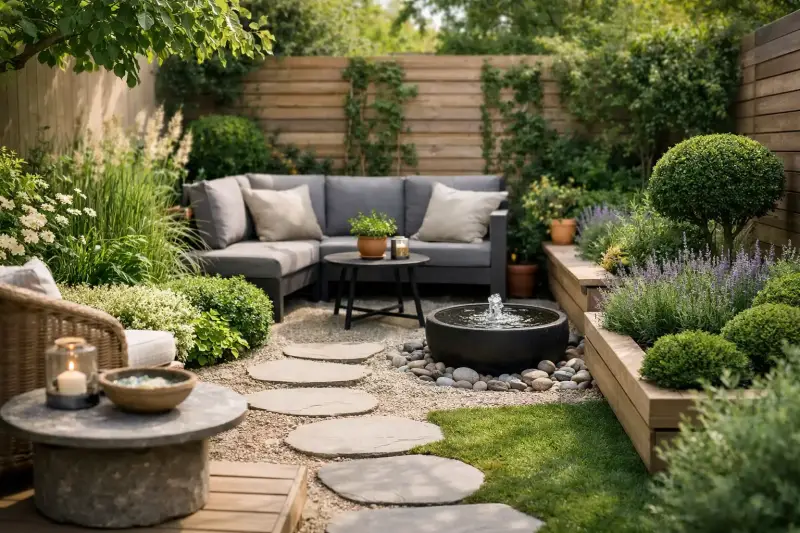
A small garden can quickly become a holding area for the things that have nowhere else to go: a tired patio set, overflowing bins, children’s toys and a lawn that is awkward to mow. Yet with a clear plan, the same space can feel private, organised and genuinely enjoyable to use. Good **garden design for small gardens** is not about squeezing in every fashionable feature. It is about making each square metre earn its place.
For homeowners who are short on time, the best result is a garden that looks pristine without creating a lengthy weekend job list. That means choosing durable materials, practical planting and a layout suited to how yourShowcase household actually lives.
## Start with the job the garden needs to do
Before selecting paving, plants or fencing, decide what matters most. A compact garden may need to be a calm place for a morning coffee, a safe play space, an attractive setting for entertaining, or simply a neat outlook from the kitchen. It can do more than one of these things, but not all with equal priority.
This decision guides every later choice. A family with young children may value a clear lawn area and robust borders, while a couple who enjoy hosting friends may prefer a larger seating terrace with generous planting around it. If the garden is mainly viewed from indoors, the sightline from key windows deserves as much attention as the route through it.
It also helps to be honest about upkeep. Delicate planting schemes, pale stone paving and multiple small lawn edges can look excellent, but they need regular care. If gardening time is limited, a simpler structure with well-chosen shrubs, tidy borders and easy-clean surfaces will hold its appearance far better.
## Make the layout feel larger, not busier
The common mistake in a small garden is to put everything around the perimeter and leave a featureless rectangle in the middle. This often makes the boundaries feel closer than they are. A stronger design creates a reason to look beyond the first few feet of patio or lawn.
A gently curved path, a planted corner, a small tree or a focal point at the far end can draw the eye through the garden. This does not require complicated landscaping. It simply gives the space depth and a sense of destination.
### Create clear zones without building walls
Different areas can be suggested through a change of material, planting or level. For example, porcelain paving outside the back door might lead to a small gravel seating area beneath a pergola, while a lawn or groundcover planting sits between them. The garden remains open, but each section has a purpose.
In narrow gardens, keep the main route direct enough to be useful. A path should not become an obstacle course just to create visual interest. If access is needed for bins, lawn equipment or a side gate, plan for it from the beginning. Practical movement through the garden is part of good design, not an afterthought.
### Use levels carefully
A raised bed or slightly elevated seating area can add character and create extra planting room. However, too many retaining walls, steps and edges can make a modest garden feel chopped up. One considered change in level is usually more effective than several.
Level changes are also a safety and maintenance consideration. Well-built steps, secure edging and reliable drainage matter, especially for homes with young children, older residents or regular visitors. A clean finish should never come at the expense of a garden that is easy to move around.
## Choose surfaces that suit everyday life
Hard landscaping takes up a large proportion of a small garden, so it has a major effect on the finished look. It should complement the house, give enough room for furniture and be straightforward to maintain.
A patio that is too small is rarely useful. Measure your table and chairs, then allow space to pull chairs back and walk around them comfortably. For a lounge-style arrangement, make room for side tables as well as seating. Trying to fit oversized furniture into a tiny terrace can make even a newly landscaped garden feel cramped.
Lighter paving can brighten a shaded space, but very pale materials may show mud, leaf marks and spills more readily. Darker surfaces can feel smart and grounding, although they may make a north-facing garden feel enclosed if used everywhere. The right choice depends on light levels, the style of the property and how much cleaning you are willing to do.
Drainage should be planned alongside the paving, not dealt with later. Water must run away from the house and avoid pooling on paths or patios. In Dorset, Somerset, Devon and Cornwall, where wet weather can be part of the picture for much of the year, this detail protects both the appearance and usability of the garden.
## Use planting to soften boundaries and add privacy
Plants are often what turn a tidy outdoor area into a garden with real character. In smaller spaces, they need to work hard. A well-planted border can soften fencing, screen a neighbouring view, bring in colour and provide year-round structure without taking over the available room.
Rather than choosing a large number of one-off plants, repeat a smaller palette. Evergreen shrubs give shape through winter, flowering perennials add seasonal interest, and ornamental grasses can bring movement without the bulk of a dense hedge. Climbing plants are especially valuable where ground space is limited, covering fences, trellis or arches with greenery.
Scale matters. A few confident, well-positioned plants often look more generous than dozens of small specimens scattered around. That said, avoid planting large, fast-growing shrubs too close to a patio, path or boundary. They may look fine in the first season but soon restrict light and access.
For privacy, trellis above a fence is often less visually heavy than a solid, taller barrier. It can support climbers and let light through while breaking up overlooking windows. In some settings, a multi-stem small tree can offer screening at the right height without closing off the whole garden.
## Keep the lawn only if it has a purpose
A lawn can make a garden feel fresh and open, but it is not compulsory. In a very small garden, a patch of grass that cannot accommodate play, seating or a clear visual break may create more maintenance than benefit. A well-designed patio, gravel area or planted groundcover scheme may be a better use of space.
Where a lawn is worthwhile, keep its outline simple. Curves can be attractive, but fussy shapes create awkward mowing and trimming. [Good lawn care](https://www.garden-kingpin.co.uk/our-services) also depends on correct preparation beneath the surface, including levelling, drainage and suitable turf or seed for the amount of sun the garden receives.
A small lawn does not mean a low-maintenance lawn. It still needs mowing, edging, feeding and occasional treatment if it is to remain green and healthy. Building this into a regular maintenance plan prevents a carefully finished garden from losing its sharp appearance after a single season.
## Light the areas you will actually use
Garden lighting should make the space safer and more inviting, not turn it into a floodlit terrace. Gentle lighting beside steps, along a route to the shed or around a seating area can extend use into the evening and add depth after dark.
Focus on a few key points: an entrance, a path, a feature plant or tree, and the main seating space. Warm, carefully positioned light is generally more flattering than bright fixtures placed at regular intervals. Any electrical work should be planned and installed properly, particularly where water, paving and planting meet.
## A professional plan saves expensive changes later
Small gardens leave little room for a mistake. A patio laid in the wrong place, a fence that feels too dominant or a planting bed that blocks access can be costly to alter once the work is complete. A considered design process looks at dimensions, sunlight, drainage, existing features, access for materials and the amount of maintenance you want to take on.
It also brings order to the build. Landscaping may involve clearance, ground preparation, paving, fencing, turfing, planting and final tidy-up. Coordinating these stages properly produces the clean lines and lasting finish that make a compact space feel considered rather than crowded.
Garden Kingpin can shape a [bespoke small-garden design](https://www.garden-kingpin.co.uk/showcase) around the way you want to live outdoors, then deliver the landscaping and ongoing care needed to keep it looking its best. The most successful small garden is not the one with the most features. It is the one that feels effortless to use, welcoming to come home to and satisfying to look after.
Add comment
Comments