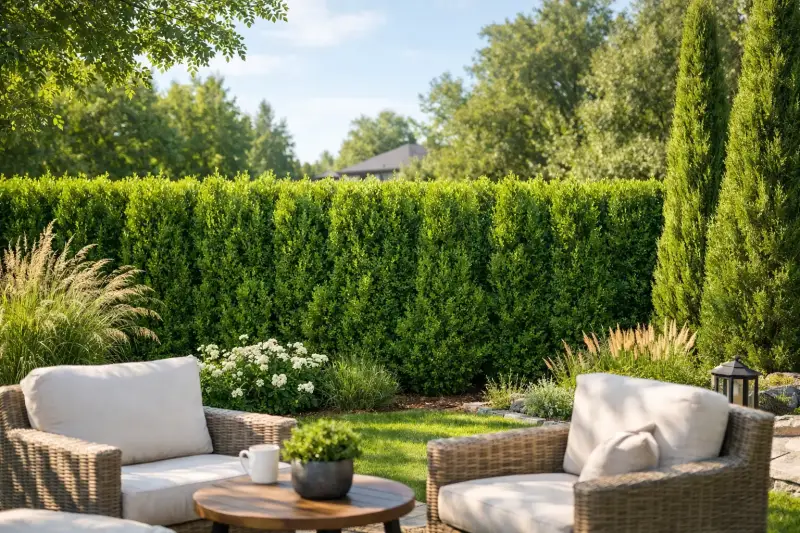
A garden can be beautifully planted and still feel exposed. A neighbouring upstairs window, a busy pavement or an open boundary can make a patio feel less restful than it should. Well-chosen privacy hedges solve that problem naturally, creating a greener, softer screen while giving the whole garden a more settled, cared-for appearance.
Unlike a fence, a hedge changes with the seasons and can support birds, insects and the character of the garden itself. It does, however, need the right plant, enough room to grow and regular attention. The best choice is not always the fastest-growing one.
## Start with the view you want to block
Before choosing a hedge, stand in the places where privacy matters most. This may be the patio, kitchen window, lawn seating area or a spot where children play. Look at the angle of the view rather than simply measuring the boundary. A low screen may be enough to hide a parked car, while overlooking from a neighbouring property may require a taller, carefully positioned hedge.
Think about when you use the garden too. A hedge that gives light filtering through its leaves may be ideal around a seating area, whereas a dense evergreen boundary can be better where you need year-round screening from a road or footpath.
It is worth considering the space on both sides of the hedge. Plants that are allowed to grow wider than the border soon become difficult to manage, cast unnecessary shade and can encroach on paths or neighbouring gardens. A neat hedge should frame the garden, not take it over.
## Choosing privacy hedges for your garden
The right hedge depends on how quickly you need screening, the style of your property and how much ongoing trimming you are prepared to arrange. Soil, exposure and drainage matter just as much. Coastal and exposed gardens in Dorset, Devon and Cornwall can be particularly hard on plants, especially where salt-laden wind is a factor.
### Yew for a refined, long-lasting boundary
Yew is one of the finest choices for a formal, evergreen hedge. Its deep green foliage creates a dense screen, it responds well to clipping and it can be kept relatively narrow where space is limited. Once established, it has an elegant, high-quality look that suits both traditional homes and more contemporary gardens.
The trade-off is patience. Yew is not the quickest option, and it is usually more expensive to buy at a useful size. It is also toxic if eaten, which should be considered in gardens used by young children or pets. For homeowners who want a crisp, permanent boundary and are happy to invest in it, yew is hard to beat.
### Laurel for faster evergreen coverage
Cherry laurel is popular because it establishes quickly and produces large, glossy leaves that make an effective visual barrier. It is useful for larger gardens and boundaries where privacy is needed sooner rather than later. Portuguese laurel offers a more refined alternative, with smaller, darker leaves and attractive red stems.
Both need room. Left unchecked, laurel can become broad and overbearing, so routine trimming is essential to keep it dense and proportionate. It is best suited to boundaries with enough depth to accommodate a substantial green screen without narrowing the garden.
### Beech and hornbeam for a softer look
Beech and hornbeam are excellent for homeowners who prefer a lighter, more natural boundary. They are deciduous, but their dry leaves often remain through winter, particularly on clipped plants, providing more screening than many people expect. Their fresh spring growth and warm autumn tones bring seasonal interest that an evergreen hedge cannot offer.
Hornbeam copes better with heavier or damper ground, while beech generally prefers well-drained soil. Neither will provide the solid winter cover of yew or laurel, so they are better where complete all-year privacy is not essential.
### Native mixed hedging for wildlife and character
A mixed hedge of native species can make a boundary feel established and alive. Hawthorn, hazel, field maple, holly, blackthorn and dog rose can be combined for changing texture, flowers, berries and seasonal colour. This approach works especially well around larger plots, rural homes and gardens where a softer transition into the surrounding landscape is wanted.
A mixed hedge is not usually the answer where a perfectly uniform, formal screen is the priority. It also requires a more relaxed approach to pruning. In return, it offers a boundary with real character and valuable habitat for wildlife.
## Avoid choosing on growth rate alone
Fast growth is tempting when a new fence has left a garden exposed or neighbouring development has changed the outlook. Yet the fastest-growing hedges can bring the greatest maintenance burden. Leylandii, for example, can create a dense screen quickly, but it needs disciplined trimming from an early stage. If it becomes too tall or too wide, cutting it back hard may leave bare brown areas that do not regrow.
A slower-growing hedge often provides the better long-term result. It is easier to shape, less likely to dominate the garden and more realistic to maintain at a tidy height. Choosing mature plants can also give a more immediate effect without committing to an overly vigorous species.
## Planting for a dense, healthy screen
A hedge only performs as well as its planting allows. The soil should be cleared of persistent weeds, loosened sufficiently for roots to establish and improved with suitable organic matter where needed. Poor drainage should be addressed before planting, as waterlogged roots will struggle whatever species is chosen.
Spacing is equally important. Plants set too far apart leave gaps for years; planted too tightly, they compete for water and nutrients. The appropriate distance varies by species and plant size, so it should be planned rather than guessed. A staggered double row can create a particularly dense screen on wider boundaries, although it needs more depth and more plants.
New hedges need reliable watering through their first growing seasons, particularly during dry spells. A mulch around the base helps retain moisture and suppress weeds, but should not be piled against the stems. Keeping the root area clear gives young plants the best chance to establish evenly.
## Pruning keeps a hedge private, not patchy
Regular trimming is what turns individual plants into a proper hedge. Young hedges benefit from light formative pruning because it encourages branching from low down. Waiting until a hedge has reached its final height before cutting it often produces a thin base and a top-heavy shape.
For most formal hedges, the aim is a slightly wider base and a narrower top. This lets light reach the lower growth, helping the hedge stay green and full from top to bottom. A hedge cut into vertical sides may look sharp at first, but it can gradually become bare near the ground.
The timing and frequency of pruning depend on the plant. Formal evergreen hedges may need one or two trims a year, while vigorous species can need more. Always check for active bird nests before work begins, particularly during the main nesting season. Where access is difficult, the hedge is mature or the finish needs to be exact, [professional hedge trimming](https://www.garden-kingpin.co.uk/our-services) protects both the plants and the appearance of the wider garden.
## Privacy should not create a neighbour problem
A good boundary improves your home without creating unnecessary tension next door. Keep an eye on height, spread and shade, especially where gardens are close together. There is no single height rule that suits every hedge, but a tall, dense screen can affect a neighbour's light or outlook and may lead to disputes if it is not managed sensibly.
Talk to neighbours before planting directly on a shared boundary, particularly if the hedge will eventually become substantial. It is also sensible to check whether a conservation area, protected tree status or local restrictions could affect planned work. A little consideration at the start can avoid expensive changes later.
## Make the hedge part of the whole garden
The most successful hedge does more than block a view. It can make a patio feel enclosed, create a calm backdrop for borders, reduce the visual impact of a shed or define separate areas in a larger garden. Underplanting with shade-tolerant shrubs, spring bulbs or low evergreen plants can soften the base and make the boundary feel designed rather than merely functional.
For gardens that are [overgrown](https://www.garden-kingpin.co.uk/blogging/3306059_overgrown-garden-clearance-service-explained), exposed or lacking a clear structure, Garden Kingpin can assess the boundary as part of a [wider landscaping](https://www.garden-kingpin.co.uk/blogging/3311942_garden-landscaping-services-dorset-homeowners-need) or garden maintenance plan. The right hedge, properly planted and consistently cared for, gives you back a private outdoor space that feels pristine, welcoming and ready to enjoy whenever you have the time to step outside.
Add comment
Comments